
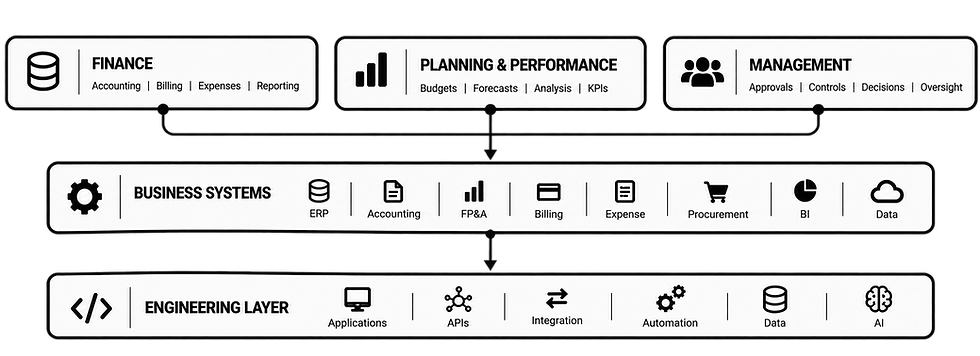
The next phase of finance is not only about doing existing work faster. It is about using better-connected data, automation and AI to understand changing numbers sooner, improve forecasting and working capital, strengthen decision-making and find new ways to improve performance and profitability.
Engineering Across Operations & Supply Chain
Financial & Management Intelligence
Bring financial and operational data together to support reporting, analysis, forecasting and management decisions.
Working Capital & Financial Workflows
Support receivables, payables, billing, expenses, approvals and other workflows that influence cash and financial operations.
Planning & Performance
Build capabilities around budgets, forecasts, scenarios, performance measures and the assumptions behind changing numbers.
AI-Assisted Finance & Decision Support
Apply AI where appropriate to analyse information, investigate variances, surface relevant context and support people working with financial and operational decisions.
A working example
From Changing Business Data to Financial Decision Support
A reference scenario showing how changing financial and operational data can be brought together for analysis, forecasting and scenario evaluation — using AI where it adds value while keeping financial logic, controls and management judgement explicit.

The Architecture Is Only Part of the Outcome
A workflow like the one above depends not only on connecting the technology, but on how financial logic, changing data, AI, controls and human judgement are designed to work together.
01 — Data & Context - Are the numbers current, consistent and supported by the operational context needed to understand what changed?
02 — Financial Logic - Which calculations, rules and assumptions must remain deterministic, particularly where financial accuracy and repeatability matter?
03 — AI & Analysis - Where can AI help investigate variances, retrieve context, compare information or explain change — and where does it add little value?
04 — Forecasts & Scenarios - How should changing assumptions flow into forecasts and scenarios without confusing model-generated possibilities with approved financial plans?
05 — Control & Decision - Which outputs can trigger defined workflows, and which require finance or management review before anything changes?
06 — Traceability & Scale - Can the data, assumptions, AI outputs, decisions and resulting actions be traced as usage, complexity and volume increase?
Built Around the Technology Involved
We can work with existing finance and business systems, APIs, data and appropriate AI model ecosystems — selecting the engineering approach around the requirement rather than designing the requirement around a preferred technology.
Finance & Business Systems
ERP · Accounting · FP&A · Billing · Expense · Procurement · BI · other appropriate platforms
AI & Model Ecosystems
OpenAI · Anthropic Claude · Google Gemini · appropriate open or specialised models
Integration & Data
REST APIs · Webhooks · Events · Data Pipelines · Structured Data · Documents · Databases · External
Data Sources
Engineering
Applications · Workflow Orchestration · Retrieval / RAG · Business Rules · Authentication · Permissions · Observability
The technologies shown are examples. The architecture and technology choices depend on the systems, workload and requirements involved.